Background Scripture (read 2-3 times during the week)
Jesus Washes the Disciples' Feet Story Summary for Kids
Jesus washed the disciples' feet as they were celebrating the Passover meal (the night we now call the Last Supper). Even though the disciples were beginning to see and understand that Jesus was God's Messiah (anointed one or Christ), they still had an important lesson to learn about the kind of Messiah he was. Unlike the kind of king many were expecting, who would overthrow the Romans and take his throne by force, Jesus showed his disciples that he came to serve others and that the disciples should follow his example.
The Setting: The Last Supper (John 13)
This story happens alongside the Last Supper. In John's gospel, we learn that sometime during the meal, Jesus got up, took off his outer clothing and wrapped a towel around his waist. Then he started washing their feet. Shouldn't a servant have done this for the disciples already? Did the disciples forget to arrange for this before the meal?
Why Did Jesus Wash the Disciples’ Feet?
You can just imagine how dirty their feet got as they were walking around the desert with only sandals on or bare feet! Typically a servant would be presented to the guests as they entered a home to wash the feet of the guests. In this story, Jesus takes on the role of a lowly servant with his disciples.
Peter Objects: “You Shall Never Wash My Feet”
This was a powerful move on Jesus' part. The disciples would not have expected their leader to wash their feet and this is why Peter objected so strongly to Jesus doing this for them. Jesus used this act of service to teach them one of the most important lessons in the Kingdom of God - in order to be considered great in the Kingdom of God, you must be a servant. He taught them this in Mark 10:35-45, he showed it to them by washing their feet, and then he died for them and all of us.
"I have set you an example": Serving like Jesus
Even though Jesus was God himself come to rescue his earth, he became like a humble servant. We aren't God, but he left us an example of how to serve others. The picture of the God of the universe with a towel wrapped around his waist, washing the feet of those he created, loved, and came to save is a powerful example of servant leadership that we can all follow in some way. This is what the church has typically celebrated on Maundy Thursday. The word "Maundy" comes from the Latin word "mando" which means, "to command." Jesus said "I, your Lord and Teacher, have washed your feet. So you also should wash one another’s feet. I have given you an example. You should do as I have done for you." (John 13:14-15)
Foot Washing in Bible Times
Foot washing was a basic practice of hospitality in the Middle East. You can find examples of this in several Old Testament passages.
(It should be noted that some denominations consider foot washing a third ordinance (along with baptism and the Lord's Supper). If your denomination has specific beliefs about foot washing, feel free to include those in your teaching to the children.)
To put this story in context, see this visualization of the chronology of Holy Week. In this visualization, this story falls within the "Last Supper" section.
My Notes
What You Will Need
Supplies
- sandals and dirt/sand to illustrate to the children why people in those days washed their feet so much.
Video Options
From Saddleback Kids
(Includes a good bit about Jesus washing the disciples' feet) From Crossroads Kids Club
Resource Sheet
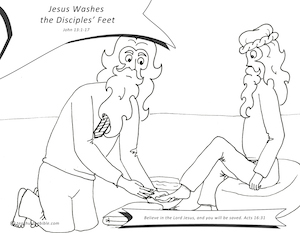
This coloring sheet depicts Jesus washing one of the disciple's feet.
1 Warm Up get your kids talking and engaged
What things do you do that make your feet dirty or smelly? Does anyone have smelly feet right now?
Would you want to wash someone else's feet that are really dirty or smelly?
2 Teach the Story teach a holistic story
Read story from a Children's storybook Bible for younger children.
For older children, read the story from an age-appropriate Children's storybook Bible or read directly from the Bible.
While you are teaching them the story, consider putting on sandals and making your feet dirty with sand or dirt to show them why foot washing was so important.
If you only do one reinforcement activity this week, we strongly urge you to do the "Wash the Student's Feet" activity. Give them an example of someone who they would see in an authority role choosing to become their servant.
3 Bible Mastery give them basic Bible skills
Scripture for Kids to Read Aloud John 13:1-17
4 Comprehension Questions make sure they understand the story
First, ask the children if they have any questions about the story. What to do if you don't know the answer?
- Where were Jesus and his disciples when he washed their feet?
- In the upper room, eating the Last Supper together before he would be crucified
- How did he wash their feet?
- He wrapped a towel around his waist, filled a basin with water, and washed their feet
- Who didn't like the fact that Jesus was washing their feet?
- Peter
- Why was he unhappy?
- He didn't think it was right for Jesus, as their leader, to wash their feet
- What was Jesus' response?
- That he must wash Peter's feet; "If I then, your Lord and Teacher, have washed your feet, you also ought to wash one another's feet."
5 Faith Questions open up a conversation about faith and the gospel; close with prayer
- In this story, we learn that God himself came to earth in the form of a man (Jesus). But instead of being the type of leader who rules over us, he came to be our servant. He came to lay his life down for us.
- How can you serve someone this week like Jesus served his disciples when he washed their feet?
6 Memory Verse hide God's Word in their heart
All 6 activities below are free to use with no sign-up — complete with instructions, supply lists, and an age label for all-ages, early elementary, or late elementary classes.
Wash the Students' Feet
- In Biblical times, foot washing was reserved for the lowliest of servants.
- As a show of hospitality upon entering someone's home, a servant would wash people's dirty, dusty, smelly feet.
- Jesus, our Lord, took on the role of a servant and told us to do as he has done.
- Fill a tub with water.
- Have students take turns washing each other's feet or the teacher can wash everyone's feet.
Trace Someone Else's Foot
- Trace someone else's foot.
- Cut out.
- Write (or have the students write) "John 13:4-5" on each footprint.
Washing Feet Relay
- Divide students into two teams.
- Each team chooses someone to get their feet washed.
- That person sits across the room with their feet in a dish pan.
- Have the relay teams run from the starting line to the person getting their feet washed.
- They have to pick up the washcloth, rub the top of the foot and the bottom of the foot to get credit.
- If you want to make this a little harder (and potentially hilarious), require each student to wash in between each toe too!
Washing Feet Craft
- Have students trace someone else's feet. If necessary, they can trace their own or use the feet printout. (I think it is more meaningful if they use someone else's feet for this project, except in the case of very young children.)
- Cut out feet.
- Color water inside the bowl on the printout sheet.
- Glue the feet so they are in the water.
- Glue a small piece of cloth to one of the feet to signify the washing.
Soapy Bubbles!
- Place chairs together in a row for a small group of children.
- Tell the children that bubbles are made from soap.
- Blow bubbles and have students pop them with their toes.
- This activity can be followed up with washing their feet!
Make Bath Salts Gifts
- Mix two kinds of salt in the bowl.
- Add a couple of drops of food coloring to the salt. (Go easy. Stick to pastel colors.)
- Add several drops of essential oil to the salt and mix well.
- Scoop into baby food jars.
- Tie a pretty ribbon around the jar.
- Add scripture label to the jar, so they are reminded of the verse when they use the bath salts.
- Give the gift to someone.
Running a kids’ ministry or Sunday school?
Ministry Edition gives your whole team lesson scheduling and teacher tools — all in one place.