Background Scripture (read 2-3 times during the week)
Story Summary
On his way to Jerusalem, Jesus entered a town on the border of Galilee and Samaria. He was approached by 10 lepers (people with some sort of skin disease) who asked to be healed. Instead of healing them right there on the spot, he told them to go show themselves to the priests. The ten lepers, who knew that going to see a priest was something you would do after your skin disease cleared up, must have had faith that Jesus was going to heal them. So they obeyed and set off to see the priest. On their way to see the priest, their leprosy cleared up!
Only one of the lepers turned back to thank Jesus. Jesus took note of the fact that 10 were healed, and the only one who came back to thank him for the healing was a Samaritan. Jesus commended him for his faith and told him to go on his way.
Why Did Jesus Send the Ten Lepers to the Priests?
After God gave Moses the instructions to build the Tabernacle, he gave him all sorts of instructions how the Israelites were to live in the wilderness and once they got to the Promised Land. One of the laws he wanted them to follow had to do with how to handle when people had some sort of skin disease. The word "leprosy" in the Bible included all sorts of different skin diseases. These laws were designed to keep this community from having an outbreak. You can read all about the laws for how to handle cases of leprosy in Leviticus 14.
Once a person's skin disease had run its course, they were to show themselves to a priest, outside the camp, who would determine whether it was safe for them to join the community again. So when Jesus said, "Go. Show yourselves to the priests," these lepers must have been overjoyed. They had been waiting for who knows how long to be ready to go see the priest and be declared clean again!?
When Were the Ten Lepers Healed?
Luke records a very important detail to this story. The lepers were not healed while they were with Jesus. Jesus told them to go to the priests while they still had leprosy. It was only after they set out that they were healed. Jesus was looking for their faith - the kind of faith where they were ready to put their whole trust in Jesus and act on that faith, even though they were still sick.
This is the same kind of faith the Israelites had to have when the crossed the Jordan River into the Promised Land. The priests who were carrying the Ark of the Covenant had to step into the Jordan River before it stopped flowing. This is the kind of faith James was talking about when he said that "faith without works is dead" (James 2:17).
Why Did Only One Leper Come Back to Say Thank You?
Luke doesn't record anything else about the other 9 lepers, but that they didn't come back to praise God and thank Jesus. This would be a great question to ask the kids what they think!
How many blessings has God given you in your life? This year? Even today? It is very easy for us to accept good things but forget that everything, even life itself, is a gift from God who created us. As James wrote, "Every good and perfect gift is from God." (James 1:17) We can take a cue from the thankful leper and instead of focusing on what you don't have, learn how to be content in every situation (Philippians 4:11). Practice gratitude and thankfulness for everything, whether small or big.
Why Does It Matter That the Thankful Leper Was a Samaritan?
Since this town was on the border of Galilee and Samaria, it appears that it had a mixture of residents - some Jews and some Samaritans. Do you remember who the Samaritans were? They came from the area of the Northern Kingdom of Israel after the kingdoms divided after Solomon.
The Northern Kingdom was taken over by the Assyrians, and the Israelites in those 10 tribes intermarried with the Assyrians and ceased to exist as a separate nation. The Samaritans were hated by those in the Southern Kingdom (Judah, the Jews). Use our Old Testament Timeline Poster as a visual aid to recall how the Samaritans came to be.
Jesus had a habit of pointing out when those outside the Jews displayed more faith than the Jews. Other examples include the Roman centurion (Luke 7:1-10) and the Canaanite woman (Matthew 15:21-28). Jesus is more interested in our faith than anything else.
What Was Leprosy in the Bible?
Leprosy was a terrible disease that was incurable during Jesus' time. Leprosy causes the skin to become scaly and white, it causes infections, and many times fingers, toes, and limbs became deformed. Lepers were considered outcasts. First, many were afraid of getting the disease from coming in contact with the disease. Also, they were considered ceremonially unclean and would not be allowed to enter the temple.
If you want the students to really remember this story, search for some images of people with leprosy. Chose photos that aren't too graphic or gruesome, but a visual here will really help them understand why all ten of the lepers should have been thankful!
My Notes
What You Will Need
Supplies
- New Testament map (showing Jerusalem, Galilee, and Samaria)
Video Options
From Saddleback Kids
From Crossroads Kids Club
Resource Sheet
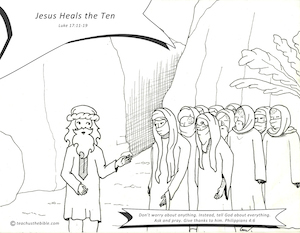
This coloring sheet depicts Jesus speaking to the 10 men with leprosy that he healed
1 Warm Up get your kids talking and engaged
Have you ever had to stay home from school because you were sick?
Today, we are going to learn about 10 men who were sick and couldn't be around others because they were afraid of getting their disease.
(Consider using the "Baby Powder Leprosy" Reinforcement Activity now as a part of the lesson)
2 Teach the Story teach a holistic story
Read story from a Children's storybook Bible for younger children.
For older children, read the story from an age-appropriate Children's storybook Bible or read directly from the Bible.
3 Bible Mastery give them basic Bible skills
Scripture for Kids to Read Aloud Luke 17:11-19
4 Comprehension Questions make sure they understand the story
First, ask the children if they have any questions about the story. What to do if you don't know the answer?
- Where was Jesus going when he came across these 10 men?
- Jerusalem
- What disease did the 10 men have?
- Leprosy
- What did Jesus tell the 10 men to do?
- Go show themselves to the priests
- When were they healed?
- On their way to showing themselves to the priests
- How many of the men came back to say thank you to Jesus for healing them?
- One
- What nationality was the man who came back to say thank you?
- Samaritan
5 Faith Questions open up a conversation about faith and the gospel; close with prayer
- In this story, only 1 of the 10 men Jesus healed came back to thank him.
- What do you have to be thankful to Jesus about?
6 Memory Verse hide God's Word in their heart
All 9 activities below are free to use with no sign-up — complete with instructions, supply lists, and an age label for all-ages, early elementary, or late elementary classes.
Baby Powder Leprosy
- Leprosy is an illness that caused light colored skin lesions. It was known to be painful and cause muscle weakness.
- Put baby powder on student's arms and hands prior to lesson.
- Have them wash it off at the appropriate time during the lesson.
Act out the Story
- We have used this activity regularly throughout the curriculum. It is a good way for students to actively get involved in the story. This increases the chances of them retaining the story.
Thank You Cards
- Writing thank you notes is becoming a thing of the past.
- Decorate cards
- Write a note of thanks to someone.
- Younger kids can copy the words "Thank you" and write their name.
Thankful Jenga
- Write thankful prompts directly on the blocks.
- Players take turns pulling a block from the tower without letting it fall.
- The player answers the prompt before successfully placing their block back on top of the tower.
- Someone in your family
- Someone at your school
- Someone who makes you laugh
- Something you use everyday
- Someone who listened when yhou told a story
- Your favorite thing in your bedroom
- Your favorite toy
- Something you love outside
- A fun memory
- Something you can do with your body (sports, play an instrument, etc)
- Your favorite snack or candy
- Your favorite place
Finger Puppets
- Use a marker to draw faces on each of the children's fingers.
- Use one color for 9 faces and a different color for the 10th, to represent the one who went back to say "Thank you."
Act Out the Story with Popsicle Sticks
- Have one child decorate 1 popsicle stick to be Jesus.
- Have another child decorate 1 stick to be the priest.
- Have other students decorate 10 sticks to be the lepers. One one side, draw happy faces, on the other side, draw sad faces and skin spots.
- As you tell the story, turn the sticks from sad faces to happy.
- During your retelling, make sure one goes back to say thank you!
Giving Thanks Game
- Have all of the students in a circle.
- Choose one student to begin by saying one thing they are thankful for.
- The next student should repeat what the first student said and then add their own thing they are thankful for.
- Go around the circle and have each student repeat what each person was thankful for and add their own.
Leprosy Tag
- Choose 2 students to be the "its" - one for Jesus and one for a leper.
- On "go", the leper runs around tagging people. As they are tagged by the leper, they must sit down.
- Jesus goes around tagging those who are sitting down to "heal" them and they can get up and run again.
- The object of the game is for either the leper to get everyone sitting or for Jesus to get everyone healed at the same time.
- You can play multiple times, with different students as the leper and Jesus.
A-Z Thanks
- Give each child a sheet with the letters A-Z.
- Have them fill in each letter with something they are thankful for.
Running a kids’ ministry or Sunday school?
Ministry Edition gives your whole team lesson scheduling and teacher tools — all in one place.